How the Discrete 8 Oryx Synergy Core became the backbone of an immersive live event at TOPLOCENTRALA, Sofia
Almost every concert you have ever attended was mixed left and right. It is the format everyone in the industry knows how to de-risk, and the compromises that come with it have long since stopped registering as compromises at all.
SFERA started from the opposite premise.

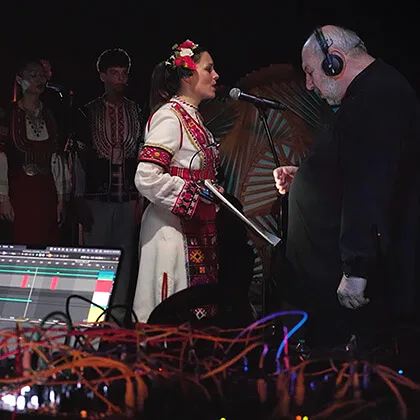
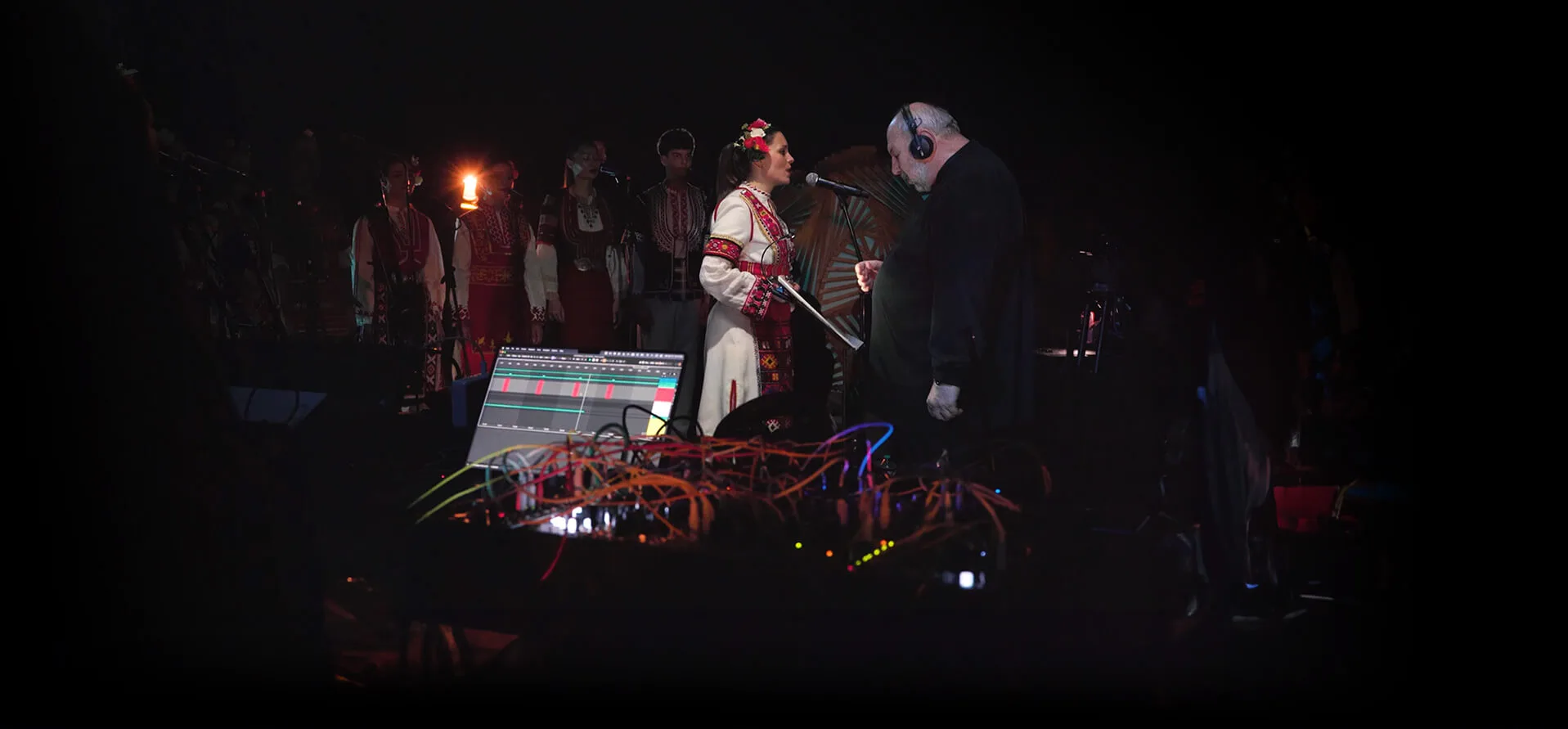
Staged at TOPLOCENTRALA – Sofia’s contemporary arts venue – the night sold out on a single proposition: a concert mixed not in front of the audience but around them. Three acts wrote and produced material from scratch for a surround room with 800 people capacity. Nothing was up-mixed from stereo sources, nothing was approximated after the fact. Where a sound sat in the room was part of the writing, not a treatment applied to it.
Doing that live means solving in one load-in afternoon what a studio gets weeks to solve – and then holding it together for an entire evening in front of a full house.
The challenge: eight channels of truth, and no margin for drift
An immersive live show applies pressure in three directions at once.
Channel count. A 7.1 bed needs eight discrete, phase-coherent analog paths driving eight amplified positions around the room. Not a stereo bus with spatial send effects – eight independent outputs with enough dynamic range to feed a large PA system with lowest possible distortion and noise.
Musician monitoring. Every player has to sit on a click, and each act needs its own cue mix – its own balance, its own effects – switchable between sets without stalling the show in order to achieve studio-grade sound in live performance.
Front of House. Live microphones and instruments still have to be captured, conditioned and folded into the spatial bed in real time, with the FOH engineer able to shape the final result.
The conventional answer is a rack: a multichannel converter, a preamp unit, a headphone distribution system, an outboard chain, and the cabling to tie it all together. On a one-night event in a venue that was never designed as a concert hall, each of those boxes is another power supply, another clock relationship, another thing that can fail at 21:00.
The SFERA team went the other way. They built the show around one rack unit and asked everything of it.
The setup: Discrete 8 Oryx as a centerpeice
1. The 7.1 bed - straight out of the DB25
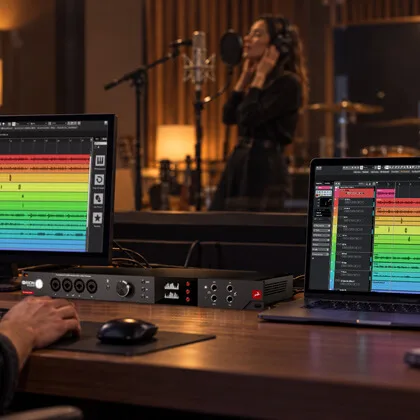
The full 7.1 program was assembled in Ableton Live. Stems, live synthesizers and microphone signals were all summed inside the session into eight spatial channels.
Those eight channels crossed to the interface over a single USB-C cable and left the Discrete 8 Oryx through its D-Sub 25 line outputs – eight analog channels feeding the FOH mixer which adds some EQ and Delay lines for the Danley PA system. One connector, one converter, eight outputs derived from the same clock.
That last detail decides whether the whole concept works. Spatial audio, and live sound in general, rests entirely on phase behavior. Conversion that isn’t sample-locked and free of jitter will smear sources and pull the image toward whichever loudspeaker is closest, and the audience stops perceiving a room and starts perceiving a set of boxes on stands.
Handling all eight channels through the Oryx’s current-generation converters (up to 130 dB of headroom) and fourth-generation 64-bit AFC™ clocking kept the positional detail intact from the first downbeat to the last. Instruments could be moved fluidly through the room with no cost to impact or resolution.

2. Four bands, four cue mixes - every headphone amp working
On the front panel, all four headphone amplifiers were in play.
Each act performed to a mix of its own with included click track, built on the four independent low-latency virtual mixers, with Synergy Core effects running in real time and with no perceptible latency baked into the monitoring path – compression on a vocal, reverb where it lifted a performance, whatever a given band needed in their ears to play well.
Crucially, all of those mixes were dialed in and stored as presets during setup, well before doors. Changeovers between acts became a preset recall instead of a scramble at the console – turning the single highest-risk moment of any multi-act evening into a menu selection.

3. Eight stage inputs, conditioned on the way in
Stage microphones and instruments ran into the Oryx’s eight discrete Class-A microphone preamps – six-transistor circuits drawing on classic console designs, offering up to 75 dB of gain.
Light Synergy Core treatment was applied at the input stage, running on the unit’s onboard 2 DSP + 1 FPGA platform rather than the host machine. From there the signals reached the front-of-house console to be blended against the spatial bed. The show computer, already carrying a full 7.1 session, never gave up a cycle to input processing.
The room
Amplification came from a Danley Sound Labs rig: three tops across the front – a pair at the sides, a pair at the rear, and a fat stack of subs at center. The result was consistent impact and transient definition wherever you stood on the floor, with a coverage pattern mapped to the 7.1 layout arriving from the Oryx.

Lighting and visuals were designed around the same idea and finished the picture. By the time the venue reached capacity, the room already had the charge that precedes something out of the ordinary.
The result
Three performances. Eight discrete channels of spatial audio. Four independent cue mixes. Eight channels of live input. A click feed to the stage. All of it running through one 1U interface, for a sold-out room, with nothing dropped.
The technical conclusion is straightforward: collapsing a rack’s worth of function into a single chassis takes a large share of the weight off an event that is already demanding. Fewer boxes means fewer dependencies, less cabling to trace under time pressure, and a far smaller footprint in a space that was never built for this.
The one that matters more is artistic. Recorded music asks to be listened to; a night like SFERA asks to be stood inside. When strong material, players who can deliver it and equipment that can carry it all land in the same room on the same night, the audience hears something they can’t get anywhere else.
Signal flow summary
| Oryx resource | Used for |
|---|---|
| D-Sub 25 line outputs (8 ch) | 7.1 spatial bed → Danley PA |
| Monitor outputs (decoupled) | Click feed to stage |
| Headphone outs H1–H4 | Four independent band cue mixes with real-time FX |
| 8 × Class-A mic preamps | Stage microphones and instruments |
| Synergy Core (2 DSP + 1 FPGA) | Latency-free input conditioning and cue-mix processing |
| 64-bit AFC™ clocking | Phase coherence across all eight spatial channels |
| Virtual patch bay | Live routing of bed, click and cue paths |
| USB-C | Single-cable connection to the Ableton Live host |
Gear
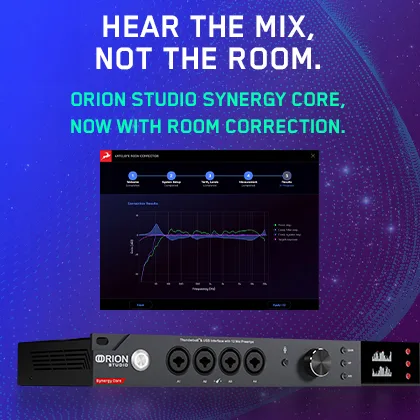
- Antelope Audio Discrete 8 Oryx Synergy Core – 26×38 USB-C audio interface
- Ableton Live
- Danley Sound Labs PA system (7.1 configuration + subs)
- Front-of-house mixing console
- Stage microphones and instruments