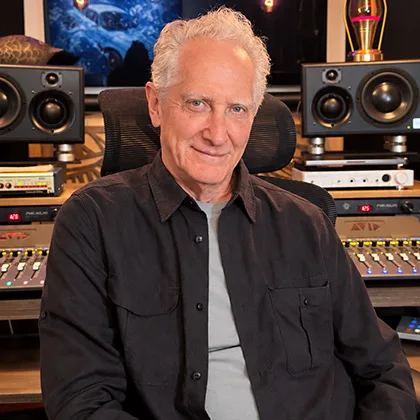
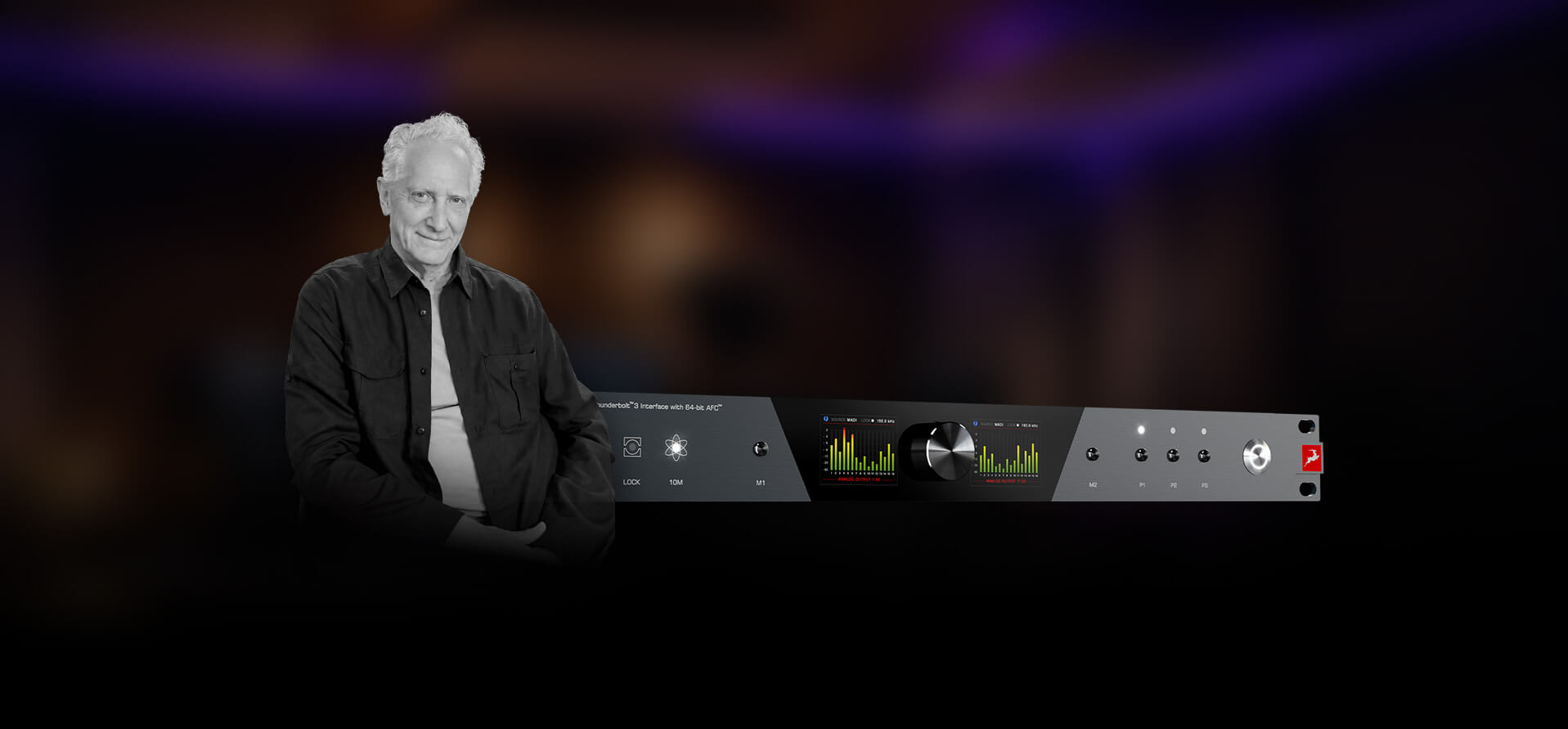
Few engineers have shaped the sound of modern records like Michael Brauer. His mixes for Coldplay, John Mayer, Aretha Franklin, the Rolling Stones and Bob Dylan have earned him seven Grammy Awards. His technique of mixing through multiple bus compressors is famous enough to carry his name: Brauerize. He has also trusted Antelope Audio for nearly two decades, from the Isochrone OCX and 10M atomic clock to the Trinity and several generations of Orion converters. Now working almost entirely in the box, he has replaced his Orion 32HD Gen 3 interfaces with the Orion 32+ Gen 4, and Antelope plugins like the DRM-60, LANG-PEQ2 and Diode 609 have found their way into his sessions. We talked about the upgrade, the day a clock moved the curtain on his mixes, what earns a plugin its place, and the moment a good rough becomes a record. “I wouldn’t even take a call from anyone else,” he says.
You’ve gone from a large-format console, through a hybrid rig, to working almost entirely in the box. Where does the Orion sit in your world today?
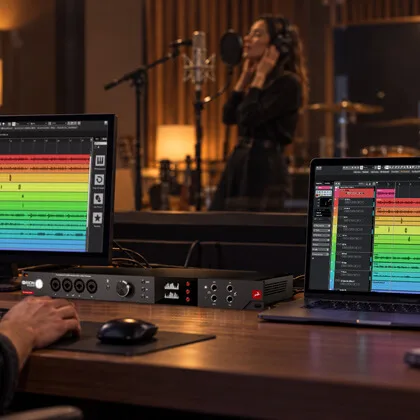
I’m now 99% digital. But there was a day when all my analog gear ran through four Orions, with the 10MX, the clock of all clocks, controlling the Trinity so I could print at three different sample rates at once. Nobody else could do that. It was insane what I had going, and it sounded great. There’s nothing like the Orion. When I removed all the analog, I was down to just the Orion.
Why was this the right moment to replace your Orion 32HD Gen 3 interfaces with the Orion 32+ Gen 4?
My first question to Antelope was: what can I expect from the Gen 4 that I don’t already hear? And the honest answer was that it would be subtle. The real advantage is Thunderbolt 3. It’s an easier, faster connection to my Mac than USB.
Sonically, the difference is so subtle that I’d need a Gen 3 rig and a Gen 4 rig side by side to A/B them. But the bottom line is it still sounds really, really good. Antelope is already at the top, so every step is incremental. If they say it sounds a little better, I’ll believe them. If it didn’t sound as good, I would notice.
The other thing is stability. With the Gen 3s I’d occasionally get a glitch, or a power supply would die. Now the power supply is external, so if it ever goes, Antelope just sends a new one. It’s like a tank. Every day it just works, and that’s all I care about.

How does the Orion 32+ Gen 4 fit into the studio, and how do its I/O and routing support the way you work?
The routing is a lot simpler than in the console days. I’ve got three pairs of monitor outputs, mix, print and reference, so with three buttons I control exactly what I’m hearing and which speakers it goes to. I wouldn’t even take a call from anyone else. I couldn’t be happier with what Antelope gives me.
I still have two or three racks of analog at my studio in New York, and practically every Orion input has a snake running to that gear, so I just go into Pro Tools and use it as hardware inserts. It’s brilliant. I’ve set it up so I can do that remotely from my home in Colorado. I open my Pro Tools session there, have my assistant put a vocal through one of my compressors and print it, and use it here. I’m working on my analog gear back east through the Antelope.
Your Antelope story goes back to around the time you were finishing My Morning Jacket’s Evil Urges. What happened when you first heard what a clock could do?
I knew nothing about clocking. I knew a 24-track sounds great, but I didn’t realize that a clock is what makes a 24-track sound like a 24-track, and not like 24 different tapes trying to sync together. I’m not technical. You have to say it to me visually.
I mix with my eyes closed, because then nothing can deceive me. With my old clock, picture yourself in the audience. The stage is six feet high and the curtain is four feet behind its edge. The bottom end was close to me, but everything else sat back by the curtain, with two blurry elliptical shapes in the middle.
Then we put in the Antelope, and the curtain moved right up to the edge of the stage. Everything came at me at the same time. No blur, just clear red velvet all the way down. It felt locked, like a 24-track, which I hadn’t realized I’d been missing. It was mind-blowing.
Then the Antelope team added the 10M, and that was another level. I called a producer friend and told him he had to hear it. Twenty minutes after they walked into his studio, he called me: “I just got it.” That one was supposed to be mine! Soon all my friends were switching to Antelope. I’ve never moved on since, and nothing has gone backwards. That’s how I hear things now: everything coming at me at once, with that clarity.
Most of your processing now happens in software. What makes a plugin earn its place in one of your mixes?
It depends on the problem. Does it fix it? Do I care why? I do not. Does it work? Yes, good. Can I tweak it a little? Yes, good. Next. I have no time to futz around, because I’m on a mission: getting the song to wake up, come alive and go absolutely nuts. And it has to have a sound, and it has to be simple, simple, simple.

What tells you a mix is emotionally working, and that it’s finished?
As the song plays, a little list pops up in my head: a bit more here, snare down a little there. I go back to the top, address all of it, let it run again, and when it feels good, I’m done.
But there’s always a moment. It sounds like a really good rough, then I do something and it’s almost an aha moment. I’m in. It feels like a record. A lot of mixers never get there. But every day I mix, I know I’m going to get there, and nothing beats that feeling.
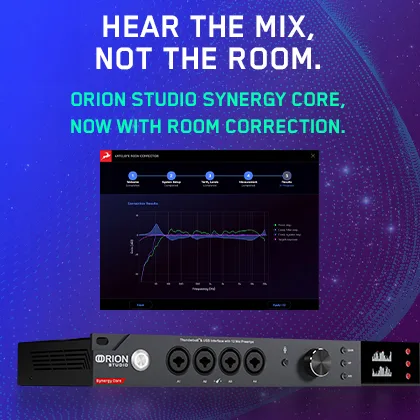
Explore the Orion 32+ Gen 4, the interface at the center of Michael Brauer’s studio.
Follow Michael Brauer:
Website: mbrauer.com
Instagram: @michael_brauer_
Instagram: @brauersoundstudios